




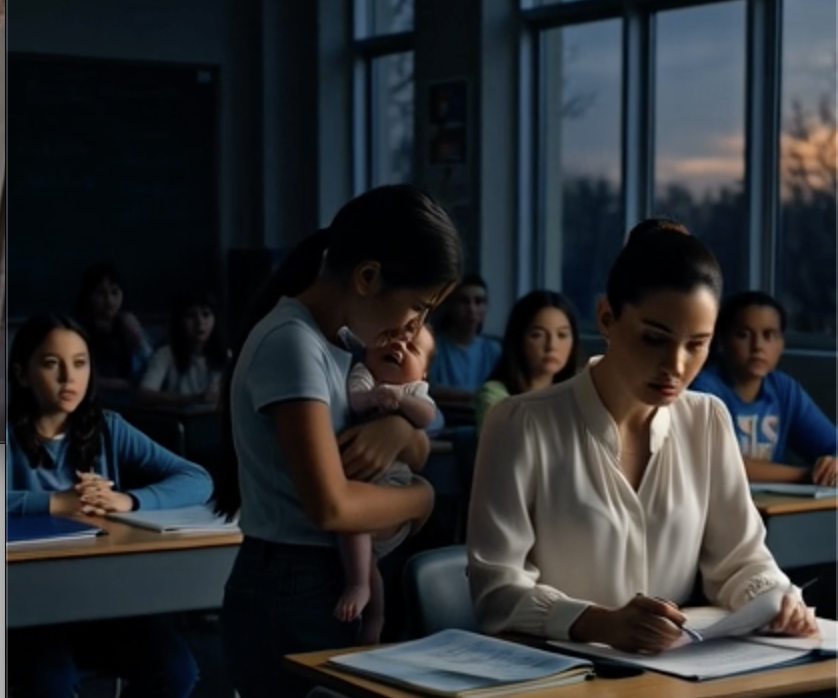
The classroom smelled like chalk dust and wet coats.
Mrs. Adler was at her desk at 7:42 in the morning, running her finger down the attendance journal the way she did every day, the classroom filling slowly around her with the particular noise of seven-year-olds — backpacks dropped, chairs scraped, somebody already arguing about something that didn’t matter. Ordinary Tuesday. Ordinary morning.
The door opened late.
Nora Calloway came in at 7:51.
Mrs. Adler looked up to ask the standard question — why are you late — and stopped.
Nora was small for seven, always had been, dark-haired and serious-eyed in the way some children are when they have spent a lot of time around adult conversations. But this morning she looked different. Smaller, somehow, and larger at the same time. Her coat was buttoned wrong, one side higher than the other. Her hair was unbrushed. There were shadows beneath her eyes that had no business being on a seven-year-old face.
And she was carrying a baby.
A real baby. Eight months old, round-cheeked, bundled in a blue blanket that had seen better days, his small fist curled against Nora’s shoulder, his eyes wide and uncertain in the fluorescent light.
The classroom went quiet the way classrooms go quiet when something happens that children instinctively understand is not for them to laugh at.
“Nora,” Mrs. Adler said carefully. “Why are you late, sweetheart?”
Nora stood in the doorway. She had clearly been holding something together for a very long time — you could see it in the set of her jaw, in the way she was breathing, in the careful controlled stillness of a child who has been pretending to be fine for longer than any child should ever have to pretend.
She opened her mouth.
And then she stopped pretending.
“My mom left us,” she said. Her voice broke on the last word like something that had been bent too many times. “A week ago. She just — she left. And it’s been me and Eli and I’ve been trying, I’ve been trying so hard, I’ve been feeding him and changing him and I looked up how to make his bottle on the school computer before it got locked and I’ve been sleeping next to him so he doesn’t cry and I—”
She stopped.
Her chin trembled.
“I can’t do it anymore,” she whispered. “I don’t know what to do anymore.”
And then Nora Calloway, seven years old, who had spent an entire week being the only adult in a house that had none, burst into tears.
Mrs. Adler was around her desk before the second sob.
She crossed the classroom in four steps and knelt in front of Nora and took the baby — Eli, eight months old, bewildered and patient — carefully from her arms. She held him against her shoulder with one arm and pulled Nora against her with the other and held both of them in the doorway of Room 7 while the rest of the class sat in complete silence.
“You did so well,” Mrs. Adler said softly into Nora’s hair. “You did so, so well. You can stop now. I’ve got you both. You can stop.”
Nora cried the way children cry when they have been waiting for permission.
Mrs. Adler learned the shape of it in pieces, over the next hour, while Eli sat in a bouncy chair borrowed from the school nurse and Nora sat wrapped in Mrs. Adler’s cardigan with both hands around a cup of warm milk.
Their father was Captain James Calloway. Astronaut. Six months into a mission aboard the International Research Station, scheduled to return in three. A good man, Nora said with complete certainty, the way children state facts about their parents before the world has had time to complicate them. He called every Sunday when the signal allowed. He always asked about her drawings.
They had been living with Diana.
Diana was their stepmother — Nora’s stepmother, Eli’s mother. She had been James’s wife for two years. She was beautiful and she smelled like expensive perfume and she was not unkind, exactly, but she was the kind of woman who was always elsewhere even when she was in the room.
Then she met someone.
A man named Victor Hale. Billionaire. The kind of name that appeared in financial newspapers and charity galas and the kind of man who collected beautiful things without much thought for what they cost other people.
Diana had left on a Monday. While James was in space. While the children slept.
She had cleaned out the accounts — the savings James had built across twelve years of his career, the emergency fund, everything accessible — and she had gone to Victor’s world and closed the door behind her without looking back.
She left no note. She left enough formula for perhaps four days. She left a seven-year-old girl and an eight-month-old baby in a house with a locked front door and a half-empty refrigerator.
Nora had found the formula. Had figured out the measurements. Had learned, from the school computer in those last days before the absence system flagged her and locked her out, how long to microwave the bottle and how to test it on her wrist the way she had seen Diana do it once.
She had not known what else to do but keep going.
So she had kept going.
For seven days.
Mrs. Adler listened to all of it. She did not cry in front of Nora, though it required more of her than most things ever had. She nodded. She asked gentle questions. She kept one hand on Nora’s hand the entire time.
Then she made calls.
The school’s emergency protocol reached NASA’s family liaison office at 9:14 AM.
At 9:31, Mission Control in Houston was informed.
At 10:07, Captain James Calloway, 240 miles above the Earth’s surface, was told that his children were alone, that his wife had gone, and that his daughter had spent a week keeping his son alive by herself.
There is no good way to receive that information in space.
James Calloway received it the only way available to him — in silence, in a pressurized module, with the curve of the Earth turning slowly in the window beside him and nothing he could do about any of it from where he was.
He requested emergency return authorization within the hour.
It was granted.
He landed eleven days later. Not the weeks it should have taken — favors were called in, procedures accelerated, people who understood what was at stake making things move faster than they were supposed to. The transport from the landing site to the city took four hours.
Mrs. Adler had kept them both.
This was not standard. This was not protocol. This was a woman who had driven to the store herself for formula and baby food, who had set up a travel cot in the corner of the teacher’s lounge, who had taken Nora home each evening and fed her a proper meal and sat with her while she did the homework Nora still, quietly and stubbornly, insisted on completing. Who had held Eli at 2 AM when he was fussy and talked to him softly in the dark about nothing in particular because that was what he needed.
Who had told Nora every single day: your father is coming. He knows. He’s coming.
James Calloway walked into the school at 3:18 on a Wednesday afternoon still carrying the particular thinness of a man recently returned from space, his legs not entirely certain of gravity yet, his face carrying eleven days of a particular kind of fear that doesn’t let go until the moment it can.
Nora was in the corridor.
She saw him and went completely still for one single second.
Then she ran.
He caught her and went down onto one knee and held her and she held him back with everything a seven-year-old body contains, her fingers gripping his jacket, her face pressed into his shoulder, and he said her name once and then couldn’t say anything else for a while.
Mrs. Adler stood in the doorway of the teacher’s lounge with Eli on her hip.
James looked up. Saw his son. Stood slowly, Nora still attached to his side, and crossed the corridor and took Eli in his free arm and stood in the hallway of an elementary school holding both of his children at once, a man who had traveled farther than most humans ever would and had never been so completely, entirely home.
He looked at Mrs. Adler over their heads.
He couldn’t find words for it.
She shook her head gently. You don’t need to.
Victor Hale learned the full story on a Thursday.
Not from Diana. From his assistant, who had been quietly thorough, who had followed a thread that began with a news item — Astronaut’s Children Found Alone, Teacher Steps In — and ended with a detailed account of exactly what Diana Calloway had done before arriving at his door.
The emptied accounts. The formula she had left behind. The seven-year-old she had left in charge of an eight-month-old. The week Nora had spent alone.
Victor was a man of considerable flaws. He knew this about himself. But there were things he would not be adjacent to.
He called Diana into the sitting room of his Malibu house on a Friday morning.
He placed his phone on the table between them with the news article facing up.
“I need you to leave,” he said. He said it very quietly, the way people speak when they have decided something completely and have no interest in argument.
Diana looked at the article. Then at him.
“Victor—”
“I’ve transferred nothing to your accounts,” he said. “I’ve had the cards cancelled. There’s a car outside that will take you wherever you need to go.” He stood. “I’ll ask you not to contact me again.”
He left the room.
Diana sat alone in the Malibu house for a long moment, in the beautiful surroundings she had traded everything for, with nothing now in any direction she looked.
The car waited outside.
It took her nowhere she had planned to be.
James Calloway called Mrs. Adler on a Sunday, three weeks after his return.
Nora had drawn a picture, he said. She wanted him to describe it. It was a drawing of a classroom, done in crayon, with a desk and a teacher and a baby in a chair and a little girl in a too-big cardigan.
Underneath it, in careful seven-year-old handwriting, Nora had written:
The day someone stayed.
Mrs. Adler stood in her kitchen and listened to him describe it and looked out the window at her garden for a long time after they said goodbye.
Outside, an ordinary Sunday. Ordinary sky.
She thought about a small girl in a wrongly-buttoned coat standing in a doorway holding a baby, holding everything together, waiting for someone to finally take some of the weight.
She thought: that is what we are here for.
She made herself a cup of tea and sat down in the quiet and let the morning be enough.