



Sarah stood in the kitchen, opening drawers with increasing urgency. Cabinet doors clicked shut one after another as she moved through the room with methodical precision.
“Have you seen my keys?” she called out.
Michael looked up from his laptop at the dining table. “On the hook by the door. Where they always are.”
She walked to the entryway, and there they were—hanging on the brass hook beneath her coat. She stared at them for a moment, her hand hovering in the air.
“Right,” she said quietly.
Michael watched her walk back through the kitchen, her fingers trailing along the counter edge. She opened the refrigerator, closed it without taking anything out, then opened it again.
“Looking for something else?” he asked.
Sarah turned to him, and there was something in her expression he couldn’t quite read. Confusion, maybe. Or concentration.
“My engagement ring,” she said. “I can’t find my engagement ring.”
Michael set down his coffee cup slowly. “Sarah.”
“I’ve looked everywhere. I thought maybe I left it by the sink when I was washing dishes, but—”
“Sarah,” he said again, gentler this time. “It’s on your finger.”
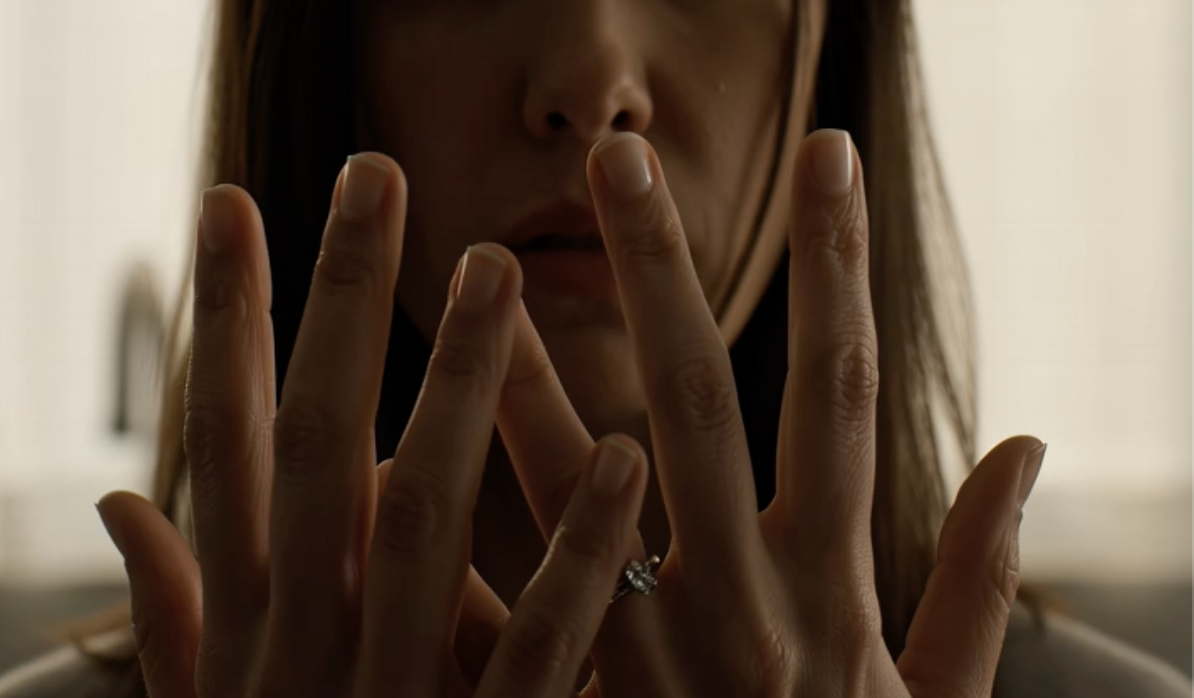
She looked down at her hands, holding them up in front of her face. The diamond caught the morning light streaming through the window. For several seconds, she didn’t move.
“That’s… that’s impossible,” she whispered.
“What do you mean?”
Her eyes met his, and he saw something that made his chest tighten—genuine bewilderment, edged with fear.
“It wasn’t there a minute ago,” she said. “I checked. I looked at my hands specifically.”
Michael stood up from the table, approaching her carefully. “Honey, you said the same thing yesterday. Do you remember?”
Sarah’s face went pale. “No. I didn’t.”
“You did. You were looking for your wedding band, and I told you it was on your finger. You seemed confused then too.”
She shook her head, backing away from him slightly. “That didn’t happen. Yesterday we had breakfast, you went to work, I went to the grocery store. We had salmon for dinner. You would have mentioned it.”
“I did mention it. I asked if you were feeling okay. You said you were just tired.”
Sarah’s hands began to tremble. She looked around the kitchen as if seeing it for the first time. “What day is it?”
“Thursday. February 13th.”
“That’s what I thought. That’s what I…” She trailed off, pressing her palms against her temples. “Something’s wrong.”
Michael reached for her gently. “Maybe we should call Dr. Morrison. Just to be safe.”
“I don’t need a doctor,” she said, but her voice wavered. “I’m not crazy. I know what I saw—or didn’t see. The ring wasn’t there.”
“I believe that you believe that,” Michael said carefully.
Sarah pulled away from him. “Don’t patronize me.”
“I’m not. I’m worried.” He paused, choosing his words. “This is the third time this week you’ve lost track of something that was right in front of you. And yesterday, you asked me who that woman was in the photo on the mantle. Sarah, that’s your sister.”
She felt the world tilt slightly beneath her feet. “Emily. Of course that’s Emily. I know my own sister.”
“But yesterday you didn’t.”
Sarah walked to the living room on unsteady legs and looked at the framed photograph. Emily’s face smiled back at her—familiar, beloved, unmistakable. The memory of yesterday felt solid in her mind: breakfast, errands, cooking dinner. But was there another memory trying to surface? Something about a photo, about confusion?
“I’m remembering yesterday,” she said slowly. “But it’s like… it’s like there’s another yesterday underneath it.”
Michael followed her into the room. “What do you mean?”
“I remember cooking salmon. I remember every detail. But when I try to think about it, there’s this other memory—fuzzier, but insistent—where I burned something. Where I was upset.” She looked at him with growing panic. “Michael, what’s happening to me?”
He sat down on the couch, and after a moment, she sat beside him.
“I think we need to see a doctor,” he said quietly. “Not because you’re crazy. But because something might be going on that we need to understand.”
Sarah looked down at her hands again. The ring glinted innocently. She tried to remember putting it on that morning, and the memory was there—but it felt manufactured, like a story she’d been told rather than something she’d experienced.
“How long?” she asked. “How long has this been happening?”
Michael hesitated. “I first noticed it about two weeks ago. Small things. You’d ask where something was, I’d point it out, and you’d seem surprised. But it’s been getting more frequent.”
Two weeks. Sarah tried to access those weeks in her memory, but they felt slippery, unstable. The harder she focused, the more the memories seemed to shift and rearrange themselves.
Then something clicked in her mind—sharp and sudden.
“Two weeks,” she repeated slowly. “That’s when the promotion interviews started.”
Michael frowned. “What?”
“The senior director position. They announced the shortlist two weeks ago.” Her eyes widened as connections began forming. “I’ve been working late, preparing presentations. And Jennifer—she’s been so helpful. Bringing me coffee every morning, staying late to help me rehearse.”
“Jennifer from accounting?”
“She’s on the shortlist too.” Sarah stood abruptly, pacing now. “Every morning. She brings me coffee from that café she likes. Says it’s her way of keeping the team motivated.”
“Sarah, what are you saying?”
“I never asked her to bring me coffee. She just started doing it. Right around the time the interviews began.” She pressed her hands to her face. “Oh my God. The symptoms started the same week.”
Michael stood too, his expression shifting from concern to alarm. “You think Jennifer is drugging you?”
“It sounds insane when you say it out loud.”
“But you’re thinking it for a reason.”
Sarah’s mind raced through the past two weeks. The fog that descended every morning around ten o’clock, about thirty minutes after drinking the coffee. The way she’d stumble through presentations she’d rehearsed perfectly. The missing time, the confusion, the gaps in her memory.
“Last Monday,” she said, “I had my presentation to the executive team. Jennifer brought me coffee right before. I remember taking the first sip, and then… the next thing I clearly remember is being back at my desk, and my boss looking concerned. He said I’d seemed disoriented during the presentation. That I’d repeated myself and lost my place.”
“Did you tell him what you’re telling me?”
“I couldn’t. I didn’t remember it happening. It was like someone told me a story about myself.” She grabbed her phone. “I stopped drinking coffee at work yesterday. That’s why today feels clearer.”
Michael moved closer. “If this is true, we need to call the police.”
“With what evidence? My own confused memories? They’ll think exactly what you thought—that I’m having some kind of breakdown.”
“Then what do we do?”
Sarah’s jaw set with determination. “We get evidence.”
The next morning, Sarah went to work with her phone camera ready and a plan. When Jennifer appeared at nine-thirty with her usual bright smile and steaming cup, Sarah was prepared.
“You’re an absolute lifesaver,” Sarah said, accepting the coffee. “I don’t know what I’d do without these morning pick-me-ups.”
Jennifer’s smile widened. “Anything for the team. Big presentation today, right?”
“The final one. Whoever does well today probably gets the position.”
“May the best woman win,” Jennifer said, but something flickered in her eyes.
Sarah waited until Jennifer left, then carefully poured the coffee into a sealed container she’d brought from home. She replaced it with coffee from the break room and threw herself into preparing for the afternoon presentation.
By noon, her mind felt clear and sharp—completely unlike the past two weeks. The presentation went flawlessly. She saw the approval in the executives’ eyes, the nods of agreement as she outlined her vision for the department.
After work, she took the coffee sample to a private lab that offered rush testing. The results came back the next morning: traces of a benzodiazepine commonly used for anxiety, but in doses high enough to cause significant cognitive impairment and short-term memory disruption.
Sarah sat in the lab’s waiting room, staring at the report. She felt vindicated and violated in equal measure. Jennifer had been systematically sabotaging her for weeks, making her doubt her own mind.
She called Michael first, then her boss, then the police.
The investigation moved quickly. Security footage showed Jennifer purchasing the medication from someone in a parking lot. Her computer search history revealed extensive research on cognitive impairment and undetectable dosing. When confronted, she broke down and confessed.
The promotion went to Sarah. Jennifer faced criminal charges for assault and tampering.
But on the morning after it was all resolved, Sarah stood in her kitchen making coffee—her own coffee—and found herself staring at her hands, checking compulsively that her ring was there. The rational part of her brain knew it was over. The deeper part, the part that had spent two weeks losing time and questioning reality, would take longer to heal.
Michael came up behind her, wrapping his arms around her waist.
“It’s going to take time,” he said quietly, as if reading her thoughts.
“I know.” She turned to face him. “But at least now I know I wasn’t losing my mind. I was fighting for it.”
“And you won.”
Sarah looked down at her ring, solid and real on her finger. This time, she trusted what she saw. This time, she trusted herself.
“Yeah,” she said. “I did.”