


On a remote island wrapped in a temporal containment field, time no longer obeyed the universe.
Inside the dome, seconds could be stretched into centuries. Years could collapse into hours.
The project was called GENESIS.
Its purpose was not to create life—but to watch it become us.
Adam was the youngest biologist on the team. Ann, the architect of the anomaly, believed evolution was not sacred—only slow. And slowness, she argued, was a flaw that science could fix.
They seeded the island with a single cell.
Then they waited.
Billions of years passed beneath the dome while only weeks passed outside. Adam watched continents rise and fall. Oceans boil, freeze, vanish, and return. Life crawled, walked, learned to hunt, learned to fear.
Eventually, Homo heidelbergensis emerged.
Almost human.
Close enough to hurt.
They lived in tribes. They buried their dead. They stared at the stars with the same confusion Adam felt every night in the lab.
One mutation remained.
The final leap.
They compressed time—400,000 years in seven days—watching culture bloom. Language patterns. Art scratched into stone. Ritual fires at dusk.
Adam felt something dangerous growing in his chest.
Hope.
But evolution never crossed the line.
After another 100,000 simulated years, nothing changed.
“No genetic drift,” Ann said, her voice tight. “No mutation cascade.”
She stared at the data like it had betrayed her.
“Evolution stopped three hundred thousand years ago,” she said.
Then, softer: “Tomorrow, we rewrite it.”
That night, Adam walked the shoreline. The sea glowed—bioluminescent jellyfish pulsed like living galaxies, ancient and alien. He knelt, mesmerized, and reached out.
Pain flared.
The jellyfish recoiled, leaving a burning mark on his skin.
Life defends itself, he thought.
Ann’s voice cut through his trance. “Adam. Emergency. Now.”
In the lab, alarms echoed. A heidelbergensis subject—awake, terrified—pounded against the containment glass.
“Inject the mutation,” Ann ordered. “Before neural stress destabilizes the genome.”
Adam’s hands shook. As he drew the sample, the needle slipped—piercing his palm. Blood spilled, warm and human, merging with the engineered gene.
For a moment, time felt suspended even outside the dome.
He could stop.
He didn’t.
He injected the subject.
And said nothing.
Days passed. Thousands of years unfolded.
The change was wrong.
Children stopped learning the old ways. Adults stared at the ocean as if listening to something calling from beneath the waves.
Then they began walking into the sea.
Not in fear.
In trust.
“They’re committing mass suicide,” one scientist whispered.
Adam couldn’t look away.
An hour later—one thousand simulated years—the ocean split open.
Something rose.
A vessel, grown rather than built. Its surface shimmered like living glass.
It opened.
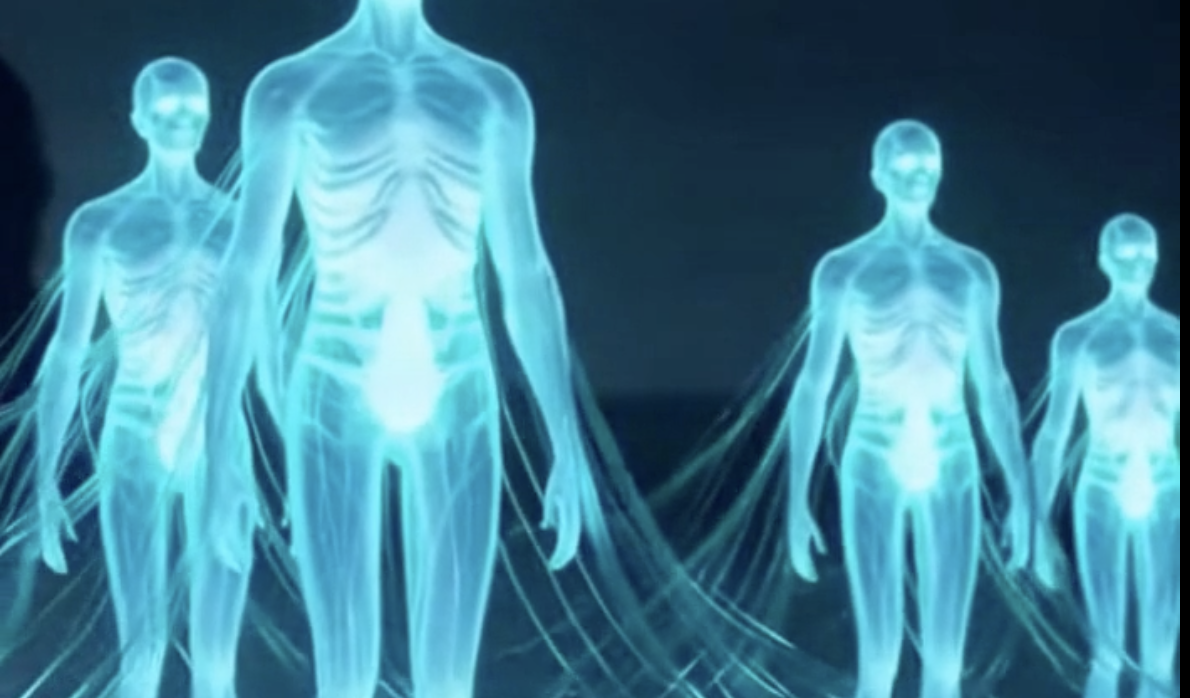
Beings emerged—humanoid, luminous, translucent blue. Their bodies pulsed with internal light, neural networks visible like constellations beneath skin.
No fear.
No confusion.
Only awareness.
Adam’s stomach dropped.
“The jellyfish,” he whispered. “Their biology… it merged with mine.”
Ann turned slowly. “You contaminated the genome.”
“I didn’t know,” Adam said. “I swear I didn’t know.”
But part of him did.
They tried to erase their mistake.
They accelerated time violently. Triggered extinctions. Earthquakes. Volcanic winters. Planetary floods.
The luminous beings adapted.
They stabilized tectonic plates. Redirected magma flows. Built machines that spoke to the planet itself.
Their ships multiplied.
Their minds expanded.
“They’re evolving faster than the anomaly allows,” someone said. “They’re rewriting physics.”
Ann’s voice broke. “We’ve created something beyond us.”
Then she froze.
“If heidelbergensis never evolved naturally…” she said slowly, “…then neither did we.”
The room went silent.
Adam felt suddenly small. Artificial. Incomplete.
“Who gave us the final gene?” he whispered.
The alarms screamed.
On the monitors, the luminous beings stood beneath the dome, staring up. Not at the sky—at the observers.
At their creators.
They raised their hands.
Energy surged.
The dome shattered like glass.
“They know,” Ann said.
“They’ve always known,” Adam replied.
On the screens, massive ships assembled—elegant, impossible, alive with light.
Leaving the island.
Leaving for the world beyond.
The scientists had tried to observe evolution.
Instead, they had proven it could be guided… stolen… repeated.
And now their children were coming home.
The final horror wasn’t invasion.
It was recognition.
Because if humanity was also engineered—
then somewhere, beyond the stars or beyond time itself,
someone was watching.And waiting to see what we would become.