


Diana stood in her daughter’s bedroom doorway, watching Lily sleep. Seven years old. Dark curls spread across the pillow. Small chest rising and falling with the innocent rhythm of childhood.
The suitcase waited by the front door.
Mike was at work. He didn’t know yet. Nobody knew except Diana and the plane ticket folded in her purse.
She’d spent seven years being someone’s wife, someone’s mother. Seven years of playdates and grocery lists and laundry and the slow erosion of the person she used to be.
Before Lily, Diana had been in theater. Small productions, community stages, nothing major—but it had been hers. Her passion. Her identity.
Then came marriage. Then came pregnancy. Then came the years that swallowed everything else.
Now there was an opportunity. A theater company in London. Open auditions. A chance to be more than just a mother, just a wife.
Diana sat at the kitchen table and wrote two notes.
The first, to Mike, was practical. Cold, even. An explanation that wasn’t really an explanation. She needed this. She couldn’t stay. The bank account information. Her lawyer’s number.
The second note, she placed on Lily’s pillow.
My darling Lily,
You’re too young to understand this now, but someday I hope you will. Mommy has a dream that she put away for a very long time. If I don’t chase it now, I’ll disappear completely. I’ll become someone I don’t recognize.
I need to do this for me. When my dream comes true, when I’m standing on that stage and becoming who I was meant to be, you’ll understand why I had to go. You’ll be proud of me.
I love you more than you can know. But I need to love myself too.
I’ll come back for you when I’m the person I’m supposed to be.
Love always, Mommy
Diana read it three times. Convinced herself it was true. Convinced herself Lily would understand.
She kissed her daughter’s forehead—Lily didn’t stir—and walked out the door with her suitcase.
She didn’t look back.
London was gray and vast and indifferent.
Diana’s savings lasted six weeks. She auditioned constantly. Theater companies, small productions, anything with a stage.
The rejections came in various forms. Some kind, some brutal. Most just silence.
After three months, she got a callback. A experimental theater collective in East London. They were doing a modern adaptation of a Greek tragedy. Ensemble cast. She’d be Chorus Member Three.
It wasn’t Broadway. It wasn’t even West End. But it was a stage.
Diana threw herself into rehearsals. She memorized every line, every movement. She ignored the emails from Mike’s lawyer. She ignored the photos he sent of Lily’s first day of second grade, Lily’s gap-toothed smile, Lily asking when Mommy was coming home.
Opening night arrived.
The theater was small, maybe eighty seats. Half full. The set was minimal—black curtains, harsh lighting, modernist and cold.
Diana stood backstage, heart hammering. This was it. This was why she’d left. This moment of becoming.
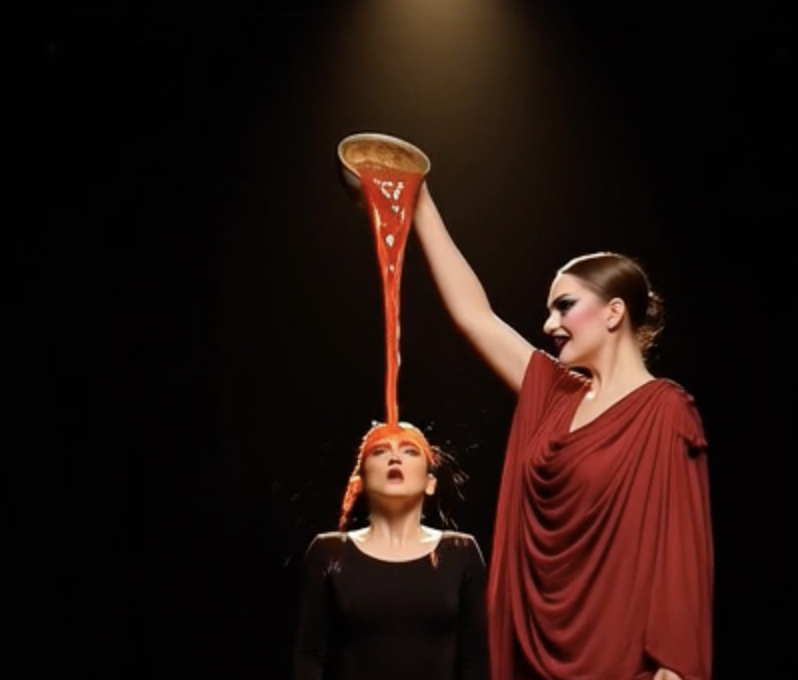
The play was experimental, deliberately uncomfortable. The director believed in “breaking the fourth wall of performer comfort.” During the climactic scene, the lead actress was supposed to throw a bowl of soup at Chorus Member Three.
They’d rehearsed it with an empty bowl.
Diana stood on stage, delivering her lines about fate and hubris, when the lead actress picked up the bowl.
It was full.
Hot tomato soup hit Diana’s face, her hair, her costume. It dripped down her neck and soaked into her clothes.
The audience gasped.
The other actors froze for just a moment—then someone laughed.
Then another.
Then the whole cast was laughing, breaking character, doubling over.
The lead actress’s voice cut through: That’s what you get for upstaging me, amateur.
Diana stood there, soup dripping from her chin, burning humiliation flooding through her body.
She ran off stage.
Behind her, she could hear the director shouting, the performance collapsing, but she didn’t stop. She grabbed her bag from the dressing room and left.
She never went back.
The theater company didn’t call. Word spread in the small London theater community—the American woman who’d caused a scene, who couldn’t take a joke, who’d abandoned a show mid-performance.
Auditions dried up.
Diana’s visa was temporary, tied to employment. She found work at a café in Shoreditch. Then a pub in Camden. Then a restaurant in Soho where tourists came for overpriced fish and chips.
She was a waitress.
The irony wasn’t lost on her. She’d left her family to be on stage, to be seen, to matter—and now she spent her days invisible, serving strangers, clearing plates.
At night, in her tiny flat-share with two roommates she barely knew, Diana would look at photos of Lily on her phone. Lily at eight. Nine. Ten.
Growing up without her.
Mike had stopped sending photos after the first year. The lawyers had handled everything. Diana sent money when she could—guilt money, meaningless money.
She never called. What would she say?
The years passed in a gray blur. The dream she’d chased had evaporated like steam, leaving nothing but the cold reality of choices that couldn’t be unmade.
By year seven, Diana had stopped going to auditions entirely. By year eight, she’d stopped thinking of herself as an actress. By year nine, she couldn’t remember why this had seemed worth it.
By year ten, she knew she had to go home.
The flight back to Chicago felt like traveling backward through time. Diana’s hands shook as the plane descended.
She took a cab to the house. Her house. Mike’s house now. The house where Lily had grown up without her.
It looked the same from the outside. Same blue door. Same maple tree in the front yard, bigger now.
Diana stood on the sidewalk for ten minutes before walking up the path.
She knocked.
Mike opened the door.
He’d aged. Gray at his temples. Lines around his eyes. He looked at Diana like she was a ghost.
Mike: What are you doing here?
Diana: I wanted to see her. To explain. I’m ready now. I’m ready to be her mother again.
Mike: You’ve got to be kidding me.
Diana: Mike, please. I know I made mistakes, but—
Mike: Mistakes? You abandoned your daughter. You left a note and disappeared for ten years.
Diana: I had to find myself. I had to try—
Mike: You had to try being selfish. You succeeded. Congratulations.
Diana: Is she here? Can I see her?
Mike started to close the door, but a voice came from inside.
Lily: Dad, who is it?
Diana’s breath caught. That voice. Deeper now. Not a child’s voice anymore.
Lily appeared behind Mike. Seventeen years old. Tall and beautiful. She had Diana’s eyes, Mike’s stubborn jaw.
And the moment Lily saw Diana, her face crumbled.
Lily: No.
Diana: Lily, sweetheart, I—
Lily: No. You don’t get to call me that.
Tears were already streaming down Lily’s face. Not tears of joy. Tears of rage, of grief, of ten years of abandonment crystallizing into this single moment.
Diana: I came back. I wanted to explain—
Lily: Explain what? That you chose acting over me? That you decided being my mother wasn’t enough for you?
Diana: It wasn’t like that—
Lily: You left me! I was seven years old and I woke up and you were gone! Do you know what that does to a kid?
Diana took a step forward. Lily took a step back.
Diana: I know I hurt you. I was wrong. I was selfish. But I’m here now. I want to make it right.
Lily: It’s been ten years. Ten years of birthdays you missed. Parent-teacher conferences. School plays—oh, the irony, Mom. I was in the school play. I got the lead. Did you know that? Of course you didn’t. You weren’t there.
Diana: I’m so sorry, Lily. If I could go back—
Lily: Did you become a famous actress? Did your dream come true?
Diana couldn’t speak.
Lily: Did it?
Diana: No.
Lily: Then what was the point? You threw away your family for nothing. You threw away me for nothing.
Diana: It wasn’t for nothing. I had to try. I had to know if I could—
Lily: You had to know if you could what? Be more important than your own daughter? Congratulations, you found out. You couldn’t.
Lily’s voice was rising now, cracking with emotion.
Lily: I used to defend you. When kids at school asked where my mom was, I told them you were following your dream. I told them you were brave. I told them you’d come back when you were a famous actress and we’d all be so proud.
Diana: Lily—
Lily: I waited for you! I watched every school play thinking maybe you’d be in the audience. I kept my phone on at night thinking maybe you’d call. I defended you to Dad when he called you selfish. I believed in you!
The words were coming faster now, years of pain pouring out.
Lily: And you know what I realized? You weren’t brave. You were a coward. Being a parent was hard, so you ran away. And you failed anyway. You failed at the thing you abandoned me for.
Diana: That’s not fair—
Lily: NOT FAIR? You want to talk about fair? I had to learn how to be a woman without a mother! I got my first period and Dad had to figure out how to help me! I had my first heartbreak and you weren’t there! I learned to drive, I applied to colleges, I lived an entire life, and you weren’t there!
Lily was sobbing now, Mike’s hand on her shoulder.
Lily: So no. You don’t get to come back now. You don’t get to explain. You don’t get forgiveness just because you finally feel guilty.
Diana: I’m still your mother—
Lily: No. You’re the woman who gave birth to me. Mike raised me. Mike was there. Mike is my parent. You’re just a stranger who looks like me.
Diana: Please, Lily. Please give me a chance—
Lily: I gave you ten years of chances. Every day I woke up, I gave you a chance to come back. You chose not to.
Mike: Diana, you need to leave.
Diana: Mike, please—
Mike: She doesn’t want to see you. You don’t get to force this.
Diana looked at her daughter—her stranger-daughter—hoping for some softness, some crack in the armor.
But Lily’s face was stone now. Tears still falling, but her jaw set.
Lily: Leave. And don’t come back.
Diana: Lily, I love you—
Lily: If you loved me, you never would have left.
The door closed.
Diana stood on the porch where she used to live, where she used to belong, and felt the full weight of her choices settle on her shoulders.
She’d left with a dream and a suitcase. She’d come back with nothing but regrets and the devastating clarity of what she’d lost.
The door didn’t open again.
Diana returned to her hotel. Sat on the bed in the dark.
She’d imagined this reunion a thousand times. In her fantasies, Lily ran into her arms. They cried together. Lily said she understood. They rebuilt their relationship, stronger for having been tested.
She’d never imagined this.
The rejection. The hatred. The look in Lily’s eyes that said you’re too late.
Diana pulled out her phone and looked at the old photos she’d kept. Lily at seven. The age she was when Diana left.
She’d thought she was choosing herself. She’d thought she was following her dream. She’d thought the sacrifice would be worth it when she was standing on stage, fulfilled and whole.
But the stage had rejected her too. Everyone had rejected her.
The dream had been a lie she’d told herself to justify abandonment.
And now she had nothing. No career. No family. No daughter.
She was forty-three years old and utterly alone.
Diana thought about the note she’d left on Lily’s pillow ten years ago. When my dream comes true, you’ll understand why I had to go.
The dream hadn’t come true. And Lily understood perfectly—understood that her mother had valued a fantasy more than her own child.
Karma, Diana realized, wasn’t punishment from the universe.
Karma was just the natural consequence of her own choices, arriving exactly on time.
She’d had everything. A daughter who loved her. A husband who supported her. A home.
And in one reckless, selfish moment, she’d walked away from all of it.
Now she sat alone in a hotel room, a failed actress, a stranger to her own child, with nothing but the echoing memory of Lily’s voice saying: If you loved me, you never would have left.
Diana had wanted to be seen. To matter. To be more than just a mother.
Now she was nothing at all.
The cruelest irony: she’d spent ten years trying to become someone worth knowing, and in the process, she’d lost the only person whose opinion truly mattered.
Lily didn’t need to forgive her. Lily didn’t owe her anything.
Diana had made her choice a decade ago.
This was simply what living with that choice looked like.
Alone. Empty. And far too late for redemption.